
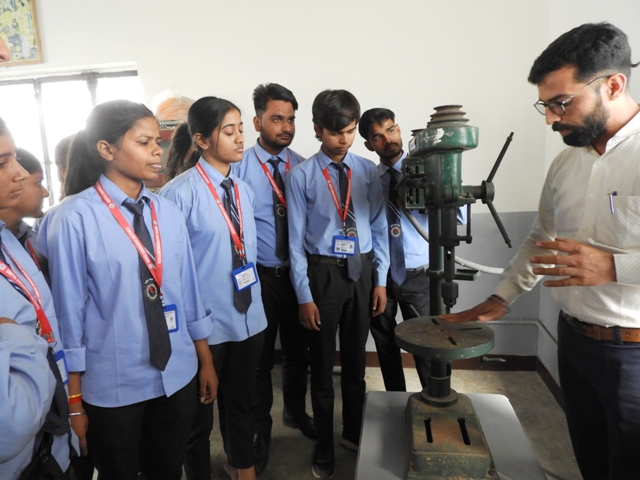
 The Mechanical Engineering is one of the oldest but diverse amongst the numerous engineering fields. In the department, extremely dynamic and well-qualified faculties consistently educate students with an avowed commitment, to meet the current and emerging needs of the society and industry. The department also conducts various technical activities to expose student to supplement their course work. The department is well-equipped and provide ample facilities both for laboratories and workshops. The department workshops also cater the needs of various departments.
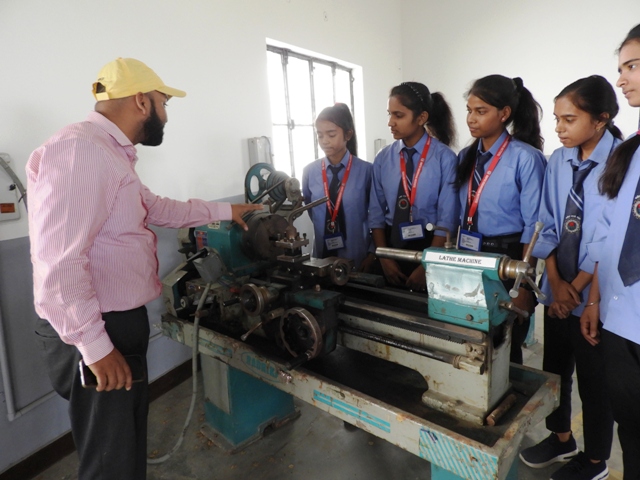 Major Labs: Applied Mechanics Lab, Applied Thermodynamic Lab, Theory of Machines Lab, Computer Aided Design Lab, Computer Aided Machine Drawing (I &II) Lab, CAM Lab, Fluid Mechanics Lab, Heat Transfer Lab, Machine Design (I &II) Lab, Manufacturing Process Lab, Material Testing Lab, Measurement and Meteorology Lab, Refrigerator and Air Conditioning Lab, and Workshop Practice Lab.
Vision , Mission and PEO Statements of the Program
Vision of the DepartmentTo be a globally acclaimed department producing competent professionals in the field of Mechanical Engineering with human values.
Mission of the Department
M1: Providing contextual knowledge
M2: Promoting effective teaching and learning practices
M3: To be an industry relevant
M4: Promoting research environment
M5: Inculcating ethics and soft skills
Program Educational Objectives (PEOs)
Our Graduates will:
PEO1: Graduates will have professional competency in Mechanical Engineering for global acceptance in industry, research and institution of higher studies.
PEO2: Graduates will develop technical skills, enabling them to meet industry challenges.
PEO3: Graduates will come up with challenges of social and professional concern
PEO4: Graduates will exhibit leadership quality and human values.
PEO5: Graduates will demonstrate communication and lifelong learning skills.
Program Outcomes (POs) & Program Specific Outcomes (PSOs)
PO1: |
Engineering Knowledge: Apply the knowledge of mathematics, science, engineering fundamentals, and an engineering specialization to the solution of complex engineering problems. |
PO2: |
Problem Analysis: Identify, formulate, review research literature, and analyze complex engineering problems reaching substantiated conclusions using first principles of mathematics,, natural sciences and engineering sciences. |
PO3: |
Design/Development of Solutions: Design solutions for complex engineering problems and design system components or processes that meet the specified needs with appropriate consideration for the public health and safety, and the cultural, societal, and environmental considerations. |
PO4: |
Conduct Investigations of Complex Problems: Use research-based knowledge and research methods including design of experiments, analysis and interpretation of data, and synthesis of the information to provide valid conclusions for complex problems. |
PO5: |
Modern Tool Usage: Create, select, and apply appropriate techniques, resources, and modern engineering and IT tools including prediction and modeling to complex engineering activities with an understanding of the limitations. |
PO6: |
The Engineer and Society: Apply reasoning informed by the contextual knowledge to assess societal, health, safety, legal and cultural issues and the consequent responsibilities relevant to the professional engineering practice |
PO7: |
Environment and Sustainability: Understand the impact of the professional engineering solutions in societal and environmental contexts, and demonstrate the knowledge of, and need for sustainable development. |
PO8: |
Ethics: Apply ethical principles and commit to professional ethics and responsibilities and norms of the engineering practice. |
PO9: |
Individual and Team Work: Function effectively as an individual, and as a member or leader in diverse teams, and in multidisciplinary settings. |
PO10: |
Communication: Communicate effectively on complex engineering activities with the engineering community and with society at large, such as, being able to comprehend and write effective reports and design documentation, make effective presentations, and give and receive clear instructions. |
PO11: |
Project Management and Finance: Demonstrate knowledge and understanding of the engineering and management principles and apply these to one’s own work, as a member and leader in a team, to manage projects and in multidisciplinary environments. |
PO12: |
Life-long Learning: Recognize the need for, and have the preparation and ability to engage in independent and lifelong learning in the broadest context of technological change. |
PSO1: |
Advanced software Tools: Develop proficiency in designing through advanced software tools related to mechanical engineering. |
PSO2: |
Multidisciplinary system: Adopt multidisciplinary approach to solve real world industrial problem. |
PSO3: |
Collaborative Work Culture: Perform ethically and professionally fostering a collaborative work culture. |
MECHANICAL ENGINEERING (Faculty Information)
S. No. |
Name of Faculty |
Highest Degree |
Designation |
Mob. No. |
1 |
Dr. KALI CHARAN YADAV |
Ph. D. |
PROFESSOR |
8510847723 |
2 |
Dr. ALOK KUMAR TRIVEDI |
Ph. D. |
ASSOCIATE PROFESSOR |
7987106417 |
3 |
Mr. DIVYANSHU SRIVASTAV |
M. Tech. |
ASSISTANT PROFESSOR |
9667110397 |
4 |
Mr. SHIVAKAR PRASAD |
M. Tech. |
ASSISTANT PROFESSOR |
8299447782 |
5 |
Mr. PUSHPENDRA KUMAR |
M. Tech. |
ASSISTANT PROFESSOR |
7906907048 |
6 |
Mrs. FAUZIA ANJUM |
M. Tech. |
ASSISTANT PROFESSOR |
7905360583 |
7 |
Mr. DHANANJAY KUMAR |
M. Tech. |
ASSISTANT PROFESSOR |
9838111711 |
8 |
Mr. SHUBHAM MISHRA |
M. Tech. |
ASSISTANT PROFESSOR |
9598024730 |